Sunday, June 27, 2010

Short Term Preparedness List

Survival PoachingAs an american preparedness website I wanted to cover some ideas specific to people living in the United States. The freedom for the individual to protect themselves and their family is one of the things that still make this country the greatest on earth. We don't yet have draconian laws that are so restrictive we can no longer stand up for ourselves and our own. Although it is becoming so riddled with cancer that it might soon die, we still have the Second Amendment in most states that allows us to Keep and Bear Arms in the defense of loved ones.

Individual preparedness is a simple concept: Take care of yourself, always. Take responsibility for everything you do and know that your life is in your own hands. Take precautions, take action. We don't always know what to do with life when it presents challenges but if we always prepare for the worst we'll usually weather life's multitudes of smaller misfortunes.
Family preparedness: basically the same as the above but with the added responsibility of young and possibly the infirm if one has older parents or special needs children. The family preparedness handbook is a very good resource that is consistently given high reviews for being thoughtful and thorough.

A good preparedness list would have these preparedness items. In addition to the small kit mentioned one should have food storage as well as a means to prepare said food for an extended period of time. The family  preparedness handbook listed above does a good job going in to the extensive methods of keeping oneself fit and hale, but if you were just looking for a list of things to weather a 3 month emergency that could include anything for earthquake preparedness to a "yay I just became one of America's swelling ranks of the unemployed," read on:

Food Storage:
Rice- How can 4 billion Asians be wrong? Any type of white rice, or parboiled. Not brown. Let your tongue be your guide as to which to choose, or get several different kinds for variety. Rice can be cooked in the most humble of means, or it can just be soaked and eaten. Unlike wheat berries it needs no further processing and will stay good almost as long as wheat. A starch is a starch is a starch. You don't need fiber. Choose based on taste and ability to soak up a lot of fats while still tasting good. Get a few 20lb bags depending on how much you eat and how much storage space you have.
Meat- Forget killing and eating Bambi... he's never around when you are hungry. Small birds, rodents, water creatures and even insects if you are desperate. You only truly need meat and fat. Carbs are entirely unnecessary in any form. To this end we want snares and traps. The Amateur Trapper And Trap-Maker's Guide is a good starting place. The importance of traps cannot be made enough: snares and conibear traps work 24/7 unattended. You will have more important things to do. Everyone has time to check a line of traps though. Unfortunately trapping is not as easy as just putting a noose on the ground with a young sapling attached to it ready to pull the hapless victim into the air. Learn now. Poaching wildlife is illegal unless you are in a survival situation however, so keep that in mind.

Survival Gardening: or Gardening When It Counts: Growing Food in Hard Times (Mother Earth News Wiser Living Series). Grow a garden now. This is another thing that doesn't just happen on its own. Learn from your mistakes now, don't wait for all the problems to happen at once. This entry is for short term survival in the 3 month time frame however, so sprouting would fit the bill here mainly. If the disaster was looking like it was going to continue longer than a few months this would become more important, so it is a good idea to get it going early and keep it going so the food is there if needed. Also, gardens make great bait if you decide to start eating the furry critters that are constantly helping themselves to the fruits of your labor.

Another thing often forgotten is extra toilet paper, razor and shaving cream, toothpaste, deodorant etc. No one says you need to look and smell like a bum just because you had a bit of bad luck.


Saturday, June 26, 2010

Making your own kits survival / first aid

Many places sell premade kits for either first aid or general survival, and while they tend to have many items they tend to run a bit expensive and the items may or may not be tailored for you specifically. A great way to get around these drawbacks to to make a list and make your own survival kit or first aid kit.

To cover all the bases for basic kits survival and general first aid we will include:
Knife: Any sharp, small knife will do. We want it to be a general utility knife ~3 inches, not necessarily a "survival knife".  The Mora Knife would do perfectly here.
Gauze: 2x2 and 4x4
Iodine: Great general purpose antiseptic, if allergic to shellfish just use alcohol.
Antibiotic ointment: a good antibiotic ointment such as bacitracin or neosporin.
Surgical tape: Don't pack bandaids, with a good micropore/transpore tape and gauze you are all set.
Bandana: Dual use, sling or head / eyes / nose / mouth protection
Popsicle sticks: Makeshift splints, and they don't take much space.
Space blanket: Multiple uses from warming to signalling and water holding.
Fire starter: whatever you choose - lighters, matches, magnesium starter etc. 

These things should fit in a very small space. To this kit which will take care of any small injury we should add some things to make life in the short term more bearable.

Fishing Line: 20lb test rolled around a campbells soup can. Inside the can we should have a few leads, hooks rubber worms etc. The tin can that the line is wrapped around can also be used to collect/boil water.


survival rifles caliber 223: or a plain 22LR. Survival rifles in these two calibers offer many advantages to something greater, for different reasons. Perhaps a future post.
pistols caliber 22 LR. Weight is a premium, this is a bit redundant too, would suggest just taking a small rifle.

The bullets caliber is small in both cases, this is due to size and weight issues. If hiking in bear country obviously a 12g with various shells for bears or birds would be the way to go.

Always be armed in the great outdoors. From providing food in an emergency to protection from 2 and 4 legged predators nothing fills the need more than a gun you are familiar with.

Monday, June 21, 2010

Equipment Roundup: Best Camp Knives for the Money

RAT-7, Canvas Micarta Handle, Plain, Cordura Sheath1- RAT-7 in 1095 steel by Ontario Knifeworks. This is probably the best deal on the market right now. The blade is a great all around compromise as a camp knife. The micarta scales are incredibly sturdy and comfortable, the blade is basically a thick wedge of steel that allows you to batton larger pieces of wood where they are too thick to chop easily.

Ontario Knife Company 8631 RAT-3 Knife (Plain Edge) w/Sheath2- RAT-3 this in D2 steel makes a great all around pocket knife. The D2 is more rust resistant than the high carbon 1095, and although it makes for a more brittle steel, in a knife this short it is not a consideration unlike the larger Rat-7 above.

New Swedish Mil. Mora Knife3-Swedish Mil. Mora Knife this is a wonderful utility knife that is great for all the lighter camp duties if one does not have the Rat-3 above. It's also incredibly cheap. The steel on this knife can take and keep an incredible edge. Very high carbon steel means it'll rust in short order if not dried after use. Or, one can use anything with a light acid content such as a potato to give it a patina that will protect it from further rust.

Cold Steel Kukri Knife Md: 35ATCJ.4- Gurkha Kukri's are knives from the east that no matter how you chop with it, it always presents a slicing edge. Absolutely wonderful style of knife. Also Kukri's need not be expensive however.

KA-BAR US Army Fighting/Utility Knife Straight Edge5- The KA-BAR  is the USMC fighting/survival knife that is the standard to which all others compare. A good solid choice for a knife.

California on 'verge of system failure’

Golden State, like many others, is nearly bankrupt and desperately needs a bailout

Barrie McKenna

Los Angeles — Globe and Mail Update Published on Friday, Jun. 18, 2010 6:01PM EDT Last updated on Friday, Jun. 18, 2010 8:21PM EDT

Arnella Sims has seen a lot in her 34 years as a Los Angeles County court reporter, but nothing like this.

Case files piling up by the thousands, phones ringing off the hook, forced midweek courthouse closings and occasional brawls as frustrated citizens queue for hours to pay parking fines.

“People think we’re becoming a Third World country,” said Ms. Sims, 55. “They don’t understand.”

It’s a story that’s being repeated all across California – and throughout the United States – as cash-strapped state and local governments grapple with collapsed tax revenues and swelling budget gaps. Mass layoffs, slashed health and welfare services, closed parks, crumbling superhighways and ever-larger public school class sizes are all part of the new normal.

California’s fiscal hole is now so large that the state would have to liberate 168,000 prison inmates and permanently shutter 240 university and community college campuses to balance its budget in the fiscal year that begins July 1.

Think of California as Greece on the Pacific: bankrupt and desperately needing a bailout. 

“We are on the verge of system failure,” warned Jean Ross, executive director of the California Budget Project, an independent think tank based in Sacramento.

None of this would matter much to anyone outside the not-so-Golden State except that California’s budget crisis is a harbinger of a grim dilemma that all Americans will soon confront. The country has built an elaborate and costly government machine, tied to a regressive tax system that can’t generate enough revenue to pay for it all.

Canadians too have a stake in all this. Dramatic cuts by state governments are threatening to derail the U.S. recovery, dampening expectations for global growth.

“This is a classic American dilemma,” explained Peter Dreier, a professor of politics and director of urban and environmental policy at Occidental College in Los Angeles. “Americans expect a lot of their government. But politicians have convinced them they’re not getting what they want.”

Americans have been “brainwashed” into believing they pay a lot of taxes, Prof. Dreier added. In fact, they are among the least-taxed people in the Western World, particularly if they’re wealthy, he said.

After unveiling a grim budget last month that scraps a popular welfare program for a million children and slashes countless other programs for the poor and elderly, California Governor Arnold Schwarzenegger complained that the state’s broken budget process has left him facing a “Sophie’s Choice.” That’s a reference to the story of the Polish Jew forced by the Nazis to choose between saving her son or her daughter from the Auschwitz gas chambers.

Experts say the U.S. government will inevitably have to come to the rescue, using its borrowing clout to save the state from near-bankruptcy or devastating service cuts. Do nothing, and the entire U.S. economy could be put at risk. California, like the country’s banks, may be too big to fail.

California is looking at a gap of $19-billion (U.S.) this year and $37-billion next year on a roughly $125-billion-a-year budget. Local governments, including the City of Los Angeles, are in similarly dire financial straits and are now scrambling to shed workers and services. 

“We have to get some federal money,” argued Ms. Ross of the California Budget Project. “The impact [of the Schwarzenegger budget] would be enough to slow down the U.S. economy. It would be bad for the U.S. and, arguably, bad for the world to do the shock therapy approach.”


And California isn’t alone in angling for a bailout. U.S. states are facing shortfalls totalling nearly $300-billion in 2010 and 2011; they also must wrestle with hundreds of billions more in unfunded pension obligations to their workers. “There are a few Greek crises brewing among the United States of America,” said economist Ed Yardeni of Yardeni Research Inc.


The task is made all the more difficult because California and virtually all other states are barred by legislation from running operating deficits, forcing them to balance their budgets annually by slashing spending, raising taxes or both. Typically, states can only borrow short-term funds, or for capital projects.


Billionaire Warren Buffett, who advised U.S. President Barack Obama during his White House run, suggested recently that a Washington bailout of California and other troubled states is inevitable. How, he wondered, can Washington deny California after saying yes to General Motors, AIG and dozens of banks.


“I don’t know how you would tell a state you’re going to stiff-arm them with all the bailouts of corporations,” Mr. Buffett said.


The alternative for many state and local governments may be default. Mr. Buffett said many state and municipal bonds are only triple-A rated because investors assume there’s a federal backstop. “If the federal government won’t step in to help them, who knows what [the bonds] are,” he said.


California’s credit rating is already the lowest of all 50 states.


How California, the largest and once most-prosperous state, got in this mess is a story decades in the making. It began with middle-class angst and a property tax revolt in the sprawling suburbs of Los Angeles. The movement would eventually sweep the country in the inflation-ravaged economy of the late 1970s, leaving government unable to pay for many of the services and entitlements people now take for granted.


John Serrano Jr., a social worker, was frustrated that he had to move his family out of East L.A. to find decent public schools for his children. He would eventually lend his name to a class-action lawsuit that would go all the way to the California Supreme Court. In a series of decisions, the court found the state’s school finance system to be unconstitutional for relying too heavily on local property taxes, which vary widely in poor and wealthy neighbourhoods. For example, a school in tony Beverly Hills would often get more than twice the funds per student than one in poor East L.A.


The landmark case would forever change the fiscal landscape of California, and many other states, shifting the financial burden of kindergarten to Grade 12 education from local to state governments, but not the tax base. K-12 education is now the State of California’s single largest expense, soaking up roughly a third of its budget.


A tax revolt would further tilt the tax burden to the state and deprive local governments of their most stable funding source – property taxes.


In the mid-1970s, California property taxes were soaring, along with real estate values, and incomes couldn’t keep pace. The result was a campaign, financed by L.A.-area apartment landlords, that culminated in the now-infamous Proposition 13 ballot initiative in 1978.


Prop. 13 rolled back and capped both residential and commercial property tax rates at 1975 levels. And it virtually guaranteed that only a revolution would reverse the measure. Proposition 13 imposed a two-thirds majority requirement for all tax bills and required local voters to approve all municipal tax increases.


“California put itself in a straitjacket that it hasn’t been able to get out of,” Occidental College’s Prof. Dreier explained.


In the years since Prop. 13, California has come to the rescue of local governments, taking on ever-greater responsibility for schools, low-income health care and welfare. And it has paid for all that with volatile sales and income tax revenue, making it tough to balance its budget when the economy stalls.


“A lot of people predicted doom and gloom in 1978. It just took a long time,” said John Tanner, executive director of Local 721 of the Service Employees International Union, which represents 85,000 government workers in Los Angeles and throughout Southern California.


Prop. 13, according to Mr. Tanner, has put schools, courts, parks and a raft of other government services in a downward spiral. “We are at an unacceptable place right now,” he said.


Perhaps no group of workers feels more targeted in the crisis than teachers. U.S. Education Secretary Arne Duncan has warned that without money from Congress as many as 300,000 teachers nationwide could lose their jobs to state budget cuts, including several thousand in California.


“It’s not easy being me these days,” said A.J. Duffy, president of the United Teachers of Los Angeles. “I have 45,000 members looking to me to save their jobs.”


His union represents teachers and other employees at 700-plus L.A. schools, where as many as 1,200 jobs are threatened.


“We’re destroying education as we know it,” Mr. Duffy lamented. “My teachers will do a great job no matter what. But it’s harder and harder to deliver the quality of education we’ve had.”


California public schools were once a beacon for the country. Now, the state ranks dead-last in student-teacher ratios, 45th in per-student spending and 36th in high school graduation.


The tax structure may be badly flawed. But even union activists acknowledge that repealing Prop. 13 outright is probably a non-starter. Recent polls show support for keeping a lid on property taxes remains strong, in spite of the budget crisis.


Experts say tax reform is the only option for California, short of a massive and unprecedented shrinking of government. And that requires an “open conversation” between voters and their elected leaders, and almost certainly higher taxes, according to Ms. Ross, the economist.


If you want good schools, you have to pay for them,” she said. “Cutting taxes doesn’t raise revenue.”


That kind of talk angers Kris Vosburgh, executive director of the Howard Jarvis Taxpayers Association, named after the L.A. homeowner who led the Prop. 13 campaign and dedicated to ensuring it’s never overturned. He said California is a high-tax state with generously paid government workers, and recession-weary taxpayers have no money to pay more.


“The bank is empty,” Mr. Vosburgh complained.


“We have tried to be all things to all people and we can’t afford to do that any more.”


But in California, and elsewhere, the price will be steep – in lost jobs and vanishing services.


Carliose Lane, 37, an animal licensing official for the City of Los Angeles, knows the city, and the state, are in a budget bind. But he can’t understand why he and the city’s entire team of animal fee collectors must pay the price with their jobs. Who, he wondered, will collect the money that pays for the city’s shelters and pet control operations after he’s laid off on July 1.


“Laying me off isn’t going to solve the city’s budget problems,” said Mr. Lane, whose $32,300-a-year salary helps support a wife and three children. “It will make them worse.”
MRE's.... might help

Friday, June 18, 2010

Russia Pushes for New Reserve Currency

ST. PETERSBURG—Russian President Dmitry Medvedev on Friday said he hosted talks with Chinese leaders about turning the yuan into a convertible reserve currency, part of a broader goal to move international reserves assets into emerging-markets currencies and away from the dollar.
The Russian president, surrounded by Wall Street chiefs at an economic forum here, also outlined steps to boost foreign investment, including a cut in the capital-gains tax and overdue financial reforms, but investors said numerous barriers still obstruct Russian investment .

Russian President Dmitry Medvedev on Friday said he hosted talks with Chinese leaders about turning the yuan into a convertible reserve currency.

Mr. Medvedev said that a year ago at a meeting of the Shanghai Cooperation Union in the Urals Mountains city of Ekaterinburg, he discussed plans for boosting the international status of the Chinese currency, which is currently tightly controlled by the government. 

Friday, he also named the Indian rupee and Russia's own ruble among the potential new reserve currencies. China and Russia have two of the three biggest war chests of international reserves.
"The future will show the correctness of our predictions, and I think the future of the world financial system is in the use of different reserve currencies and the creation of a multi-currency portfolio," Mr. Medvedev said.

"Three to five years ago, any discussion of this seemed like a fantasy that may never come true," he said. "Now we're discussing it in absolute seriousness with a number of countries, including our American partners, who are perhaps least interested in other currencies replacing the dollar."
The growing economic clout of Russia, China and India means it makes some sense for their currencies to form a greater share of global reserves, said Neil Mellor, currencies analyst at the Bank of New York Mellon in London, adding that it will be a "very, very long-term shift."

Interview With Medvedev
Russian President Dmitry Medvedev voiced concern about the fate of Europe's common currency and said the Gulf of Mexico oil spill could threaten the survival of BP. Asked whether Europe's debt turmoil could threaten the euro, Mr. Medvedev said, "I don't exaggerate the threat, but it can't be underestimated."

China will probably move cautiously toward making its currency convertible because doing so completely would allow unrestricted access to domestic securities. In recent years, Russia opened its ruble and bond markets, only to see the currency face a painful devaluation in late 2008 and early 2009 after commodity prices fell. The central bank still acts to control the ruble's volatility as Russia faces alternate bouts of speculative capital, attracted by relatively high interest rates and oil price gains, and sharp selloffs amid global risk aversion.

Besides boosting Russia's clout abroad, Mr. Medvedev said he would eliminate taxes on certain long-term direct investments in Russia by 2011 and clear the way by the end of the year for a central securities depository, which would allow large investors concerned about trading and holding stocks and bonds to invest locally in Moscow for the first time. 

The lower level of parliament on Friday gave preliminary approval to legislation that would allow authorities for the first time to pursue insider trading.

"Russia needs a real investment boom," Mr. Medvedev said. His chief economic aide has said that in the absence of rising commodity prices, Russia requires foreign investment to boost annual economic growth above 5% annually, a level other major emerging-markets include Brazil, India and China are seeing this year.

Still, some investors are inured to the influence of friendly rhetoric repeated by the Kremlin, this week against the backdrop of the annual St. Petersburg International Economic Forum, attended this year by Citigroup Inc.'s Vikram Pandit, J.P. Morgan Chase & Co.'s James Dimon and Morgan Stanley's John Mack.

"Russia has been toying around with the idea of a central depository for about 20 years," said John T. Connor, portfolio manager of the Third Millennium Russia Fund. "They have a theoretical grasp of what they'd like to do, but the rubber hasn't hit the road."

Mr. Medvedev, widely seen as more investor-friendly than his Kremlin predecessor, Prime Minister Vladimir Putin, is probably seeking to "improve market infrastructure after its failings in 2008," said Mattias Westman, chief executive of Prosperity Capital, which manages Norway's oil investments in Russia. "The timing is uncertain, but they usually keep explicit promises."

In fact, the tax cuts Mr. Medvedev mentioned may not even be needed, said Renaissance Capital founder Peter Jennings, who expects to see renewed foreign investment in emerging markets this year "anyway."

Russia attracted only $5.8 billion in foreign direct investment in the first quarter of 2010, the slowest start to a year since 2006. Last year's $38.7 billion of foreign direct investment was only about half of that of 2008, according to central-bank data. 

Yet the number of direct-investment projects climbed to 170 last year from 143 in 2008, according to Ernst & Young. Meanwhile, Russia-focused investment funds saw $1.9 billion of inflows--more than Brazil, India or China--in the first half of 2010, according to Emerging Portfolio Fund Research.
—Katie Martin in London and Ira Iosebashvili in St. Petersburg contributed to this article.

Google gives the US Government access to Gmail

Google should not expect to be beyond international criticism while it offers the US Government access to its data on request but lambasts other governments for interfering with the rights of online users.
It has been telling to watch some of our peers in the press work the controversy over Senator Conroy's criticism of Google's privacy record on ABC radio last week as he was questioned on his internet filtering policy.
The headlines only illustrated the ferocity of opposition to Conroy's nanny-state filter and just how well marketed Google's "do no evil" mantra is. Scribes just couldn't believe a minister would have the nerve to question Google.
Like or loathe his policy, the Senator has grounds to point out the contradiction Google is in. The search company condemns the Chinese Government for censoring its results and Australia for planning to do the same while it breaks faith with its users around the world by sharing their data with the US Government.
The Patriot Act introduced by President Bush - which allows US authorities to search telecommunications and email communications to fight the 'war on terror' - was not designed by Google. But complying with it places the company in an awkward position.
Representatives from Google Australia have since confirmed the company's policy of complying with these United States government regulations.
"We're committed to protecting user privacy when faced with law enforcement requests, and have a track record of advocating on behalf of users in the face of such requests," the company told iTnews in a statement. "We scrutinise each one to ensure that it adheres to both the letter and the spirit of the law before complying, and do our best to notify the subject named in any such requests to give them the opportunity to object.
"Like all law-abiding companies, we comply with U.S. laws and legal processes."
Google is  thus in a contradictory position to comment on government interference with a citizen's data. It says, like the government, that it only wants to interfere with a customer's data in the case of suspected child porn - which sounds straight out of the Minister's songbook. 
At least Australians have always known where we stand with Senator Conroy and Prime Minister Kevin Rudd. Whether we like it or not, both of our major political parties have promised their stakeholders an internet filter for some time. And Senator Conroy always has the advantage of leaning back on the fact that the ALP - at a high level - made its "cyber-safety" agenda public before it was elected to government.
I don't expect opponents of the filter are going to let Senator Conroy steamroll filtering legislation through Parliament without a very good and worthy fight. But I'd suggest activists be wary of their allies.
After all, as Australian citizens we can always vote the Rudd Government out if it displeases us.
We have far less power over Google.

Central banks join gold rush


NEW YORK (CNNMoney.com) -- Foreign governments have been getting in on the recent gold rush, driven by continued fears about Europe's debt crisis and the pace of the global economic recovery.

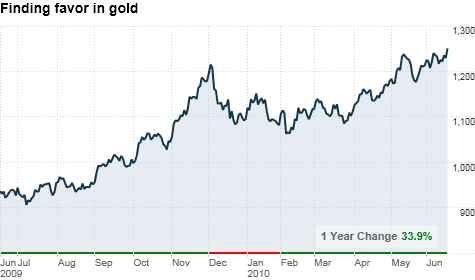
Those concerns have been propelling the precious metal to record highs over the past 18 months. In fact, gold closed at a fresh record high of $1,248.70 an ounce Thursday.

Last year, foreign central banks were net buyers of gold for the first time since 1997. India, China and Russia have been the biggest buyers. And more recently, the Philippines and Kazakhstan jumped into the fray with big purchases of the precious metal during the first quarter, according to data released by the World Gold Council Thursday.

What's behind the buying binge?

Each country has its own unique reasons, but there are a few broad trends that unite them all, said Natalie Dempster, director of government affairs for the World Gold Council.

Like many individual investors, foreign governments prefer to spread their wealth around to decrease their risk.

The U.S. dollar is typically the main reserve asset because it's considered to be more stable than other holdings, while the euro comes in as the second most popular reserve currency. But gold is not far behind. The precious metal plays an important role as a hedge against inflation, which could devalue paper currencies.

Unlike paper currencies, gold has a tangible value and that value is not dependent on any one country's economic policies.

When the financial crisis drove down the dollar's value in 2009, and Europe's debt woes pushed the euro to fresh four-year lows earlier this month, investors and foreign central banks flocked to safe-haven assets like gold.

Add rising deficits in both Europe and the United States to the mix, and currencies have become increasingly questionable assets, said Jeffrey Nichols, managing director of American Precious Metals Advisors and senior economic advisor to Rosland Capital.

That's why it's no surprise that foreign central banks overall have turned from sellers into buyers of gold in the last year, he said.

Who's buying gold?


Russia and Kazakhstan: As far as public records show, Russia appears to be the largest buyer of gold among central banks so far this year. In the first quarter of 2010, Russia's central bank increased its gold reserves by 26.6 metric tonnes, or about $1.2 billion at today's price, according to World Gold Council data. That's in addition to the 117.63 tonnes that Russia added in 2009.

Russia has been adding to its gold reserves steadily for more than three years, partly through buying its own domestic mine production. It considers gold both a symbol of prestige as well as a way to bolster the country's credit worthiness, Nichols said.

Kazakhstan, the third largest buyer so far in 2010, has a similar strategy, although at a much lesser level. The former Soviet-controlled country bought 3.1 tonnes, or $137 million, of the precious metal in the first quarter.

Philippines: After Russia, the Philippines falls a distant second as a buyer, after purchasing 9.6 tonnes, or about $424 million, of gold earlier this year.

The Philippines also buys its domestic production as a way of supporting local industry and as an inflation hedge, but its reserves usually fluctuate more than Russia's because the country often sells it at a later date on the open market.

India: While India has yet to publicly announce any major gold buys this year, the country bought a massive 200 tonnes, or what amounts to about $8.8 billion at current prices, from the International Monetary Fund in November.

The move, which multiplied India's reserves by 55%, was seen as a way for the country to diversify its reserves and reinforce the perception among Indian consumers that the metal is a reliable and safe asset, the World Gold Council said.

China: China is considered a stealth buyer of gold, said Boris Schlossberg, director of currency research at Global Forex Trading. As the world's largest producer of the metal, China often buys gold from its own mines and doesn't report those sales publicly. But in April 2009, China did admit to having added 454 tonnes, or a 76% increase, to its reserves since 2003.

Analysts suspect the country is continuing to buy gold and could in fact, be the world's largest buyer consistently. It simply doesn't reveal it's pro-gold stance proudly, however, because China is also the world's largest holder of U.S. Treasurys.

Announcing an aggressive gold buying spree is not in China's best interest because, for one, it might push gold prices higher. Secondly, it could devalue the U.S. dollar, which would subsequently lessen the worth of the country's portfolio of U.S. government bonds, Schlossberg said.